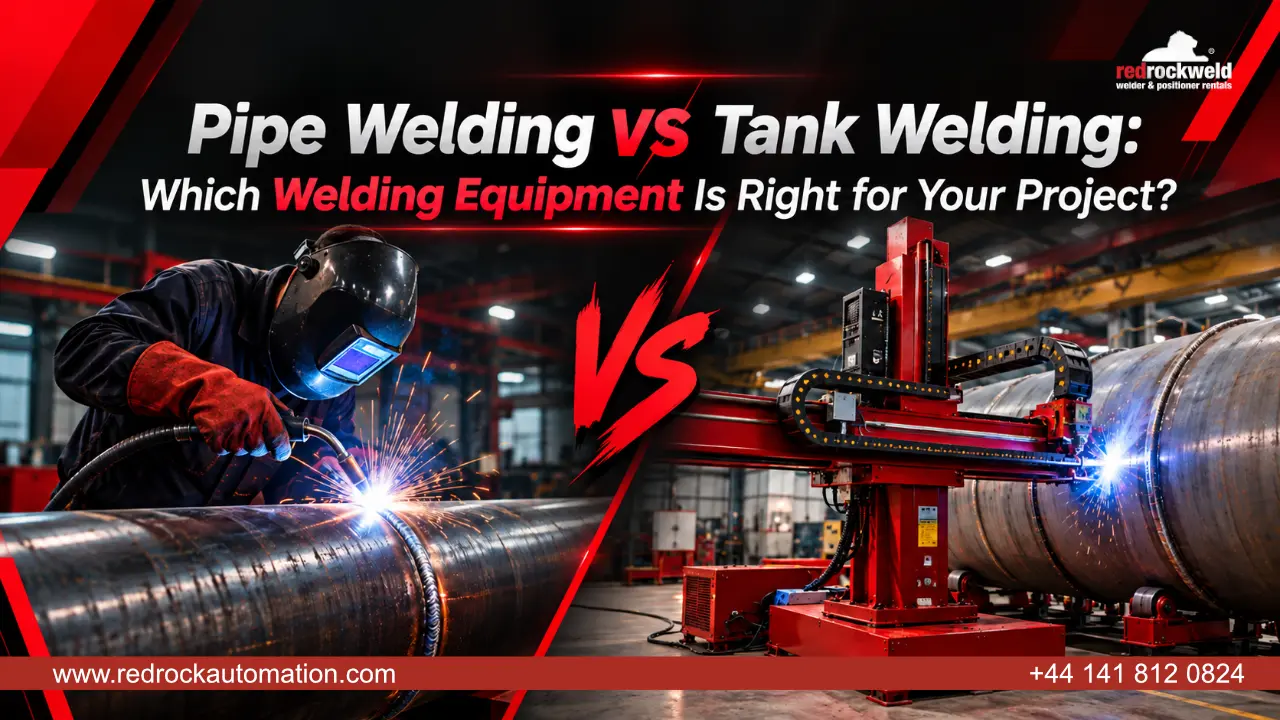
Pipe Welding vs Tank Welding: Which Welding Equipment Is Right for Your Project?
Key Takeaways
Pipe Welding vs. Tank Welding
Different Welding Challenges and Structural Requirements
Pipe Welding Equipment and Applications
Tank Welding Equipment and Applications
Specialized Equipment for Better Weld Quality and Productivity
Choosing the Right Welding Equipment for Your Project
Conclusion
Industries require robust joining methods that take into account the exact geometry and size of the material being worked with. Choosing the appropriate equipment between pipes and storage tanks is critical to ensure proper integrity and avoid expensive leakage issues. Here are some of the major differences between them to help choose the right machinery for your upcoming project.
Pipe and Tank Welding Explained
These are two specialized processes for welding cylindrical shaped metallic components for the transportation and storage of different fluids or gases. Pipe welding refers to the joining of thin hollow pipes while tank welding involves the creation of huge tanks through assembling huge curved plates.
Special Structural Geometries
In pipe welding, the circumference of the steel is quite small and needs to be continuously repositioned as it is curved. In contrast, when it comes to huge storage vessels, there are huge steel plates that need to be joined by creating enormous seams across broad flat surfaces.
Different Welding Challenges
Pipe welders generally have to work on out-of-position seams in very tight trenches or overhead racks. Whereas tank fabricators have to work on long horizontal or wide vertical seams across open scaffoldings.
Different Equipment Requirements
Pipeline construction uses compact external clamping devices and portable orbital power supplies that travel along narrow tracks. Tank fabrication requires automatic travel carriages, large turning rolls, and sub arc tractors.
Use, Applications, and Equipment Description
Pipe Alignment Clamps
The external and internal pipe clamps align the two identical tube ends together to make sure there is an even gap before the arc is initiated. The tool prevents offset edges so that the root pass makes an even penetration along the entire length of the weld joint. By utilizing proper fit-up equipment, many labor hours are saved from cutouts due to poor alignment.
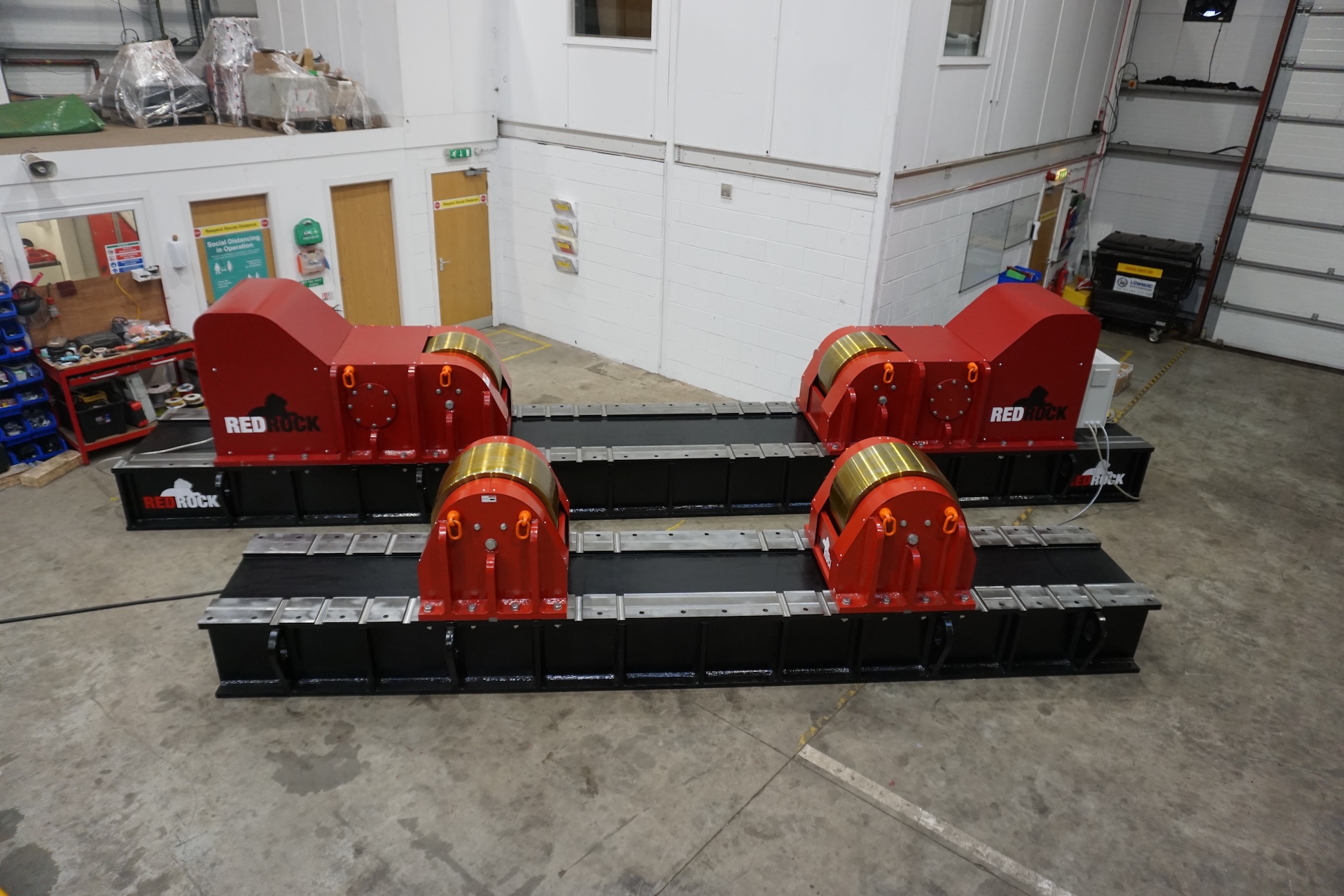
Pipe Turning Rolls and Positioners
The turning rolls turn cylindrical pipes while the welding gun remains static so the welder can work in the horizontal position. This automatic motion provides a consistent speed and stability of the melt pool without the necessity to frequently move the hand. The fabrication shop achieves substantially increased deposition rate and less operator fatigue during long shifts on spool assemblies.
Portable Orbital Welding Machines
In orbital machines, there is a mechanical weld head which moves around a clamped and stationary pipe within a guide track in the form of a circle. The computer controls the travel speed, voltage, and wire feeding to create the even root and cap passes on critical pipelines. Such machines provide repeatable joints of high purity that can easily pass the radiographic tests.
Tank Shell Girth Welders
The girth welder is an automated machine that rests across the outer edge of the steel tank storage plate to weld circumferential joints. It hangs from the top edge and operates continuously, welding large amounts of metal in a submerged arc method. The contractor completes the horizontal shell seams ten times faster than the traditional method of using handheld stick electrodes.
Vertical Seam Climbing Tractors
The vertical traveling carriage is attached to the tank by guide rails or magnets to climb from the bottom of the seam to the top of the seam. The motor drives an oscillating torch vertically up at a steady pace to weld the wide vertical groove without sagging. This ensures that the beads have a smooth profile and slag inclusions cannot occur.
Submerged Arc Power Sources
Amperage power sources provide very high current for submerged arc welding. The flux particles cover the entire molten weld area and do not emit any sparks or fumes. This allows the welder to achieve deep penetration in addition to fast metal deposition in thick tank base plates and pipe wall.
Rotators for Heavy Tanks
Turning beds capable of supporting huge cylinder section vessels which are very heavy are made of sturdy material like polyurethane or steel. Turning beds move large cylinders via wheels to make sure that welders can comfortably weld internal and external circumferential joints in one spot. The movement of the large cylinders in a stable manner promotes safety of the workshop because there will be no need for any hazardous overhead cranes during alignment of the seam.
Equipment for Backing and Purging
Baffles and bladders purge the inner chamber of stainless steel pipes to allow retention of inert shielding gas called argon in the inner cavity. Removal of atmospheric air behind the joint ensures that there is no back side sugaring and the root bead is corrosion resistant. Inner profiles have to be clean to avoid any turbulence in fluids.
Diesel Field Welding Generators
Durable diesel engines welders produce multiprocess electrical power supply that can reach isolated pipelines right of way and jobsite. Auxiliary power sources will be available through grinders, lighting and preheat jackets without being connected to the grid.
Ceramic Weld Backing Tapes
The non-conductive ceramic tiles are applied onto the back of the open tank plate joints using a heat-resistant aluminum tape. The mold ceramic material is capable of sustaining the weight of the molten steel, making it possible for the operator to make full one-sided root passes safely, free from blow-through issues. Using ceramic backing allows saving time because back-gouging of reverse joints becomes unnecessary.
Conclusion
Choosing the right equipment will depend entirely on the size of your fabrication job and the type of joints to be made. Pipe welding requires maneuverable compact orbital machines and positioning tables while the tank building requires submerged arc tractors and climbers. Buying the right specialized equipment guarantees quality welds, safety on-site and profitability of your projects. To purchase the right welding equipment, get in touch with our team at Redrock!