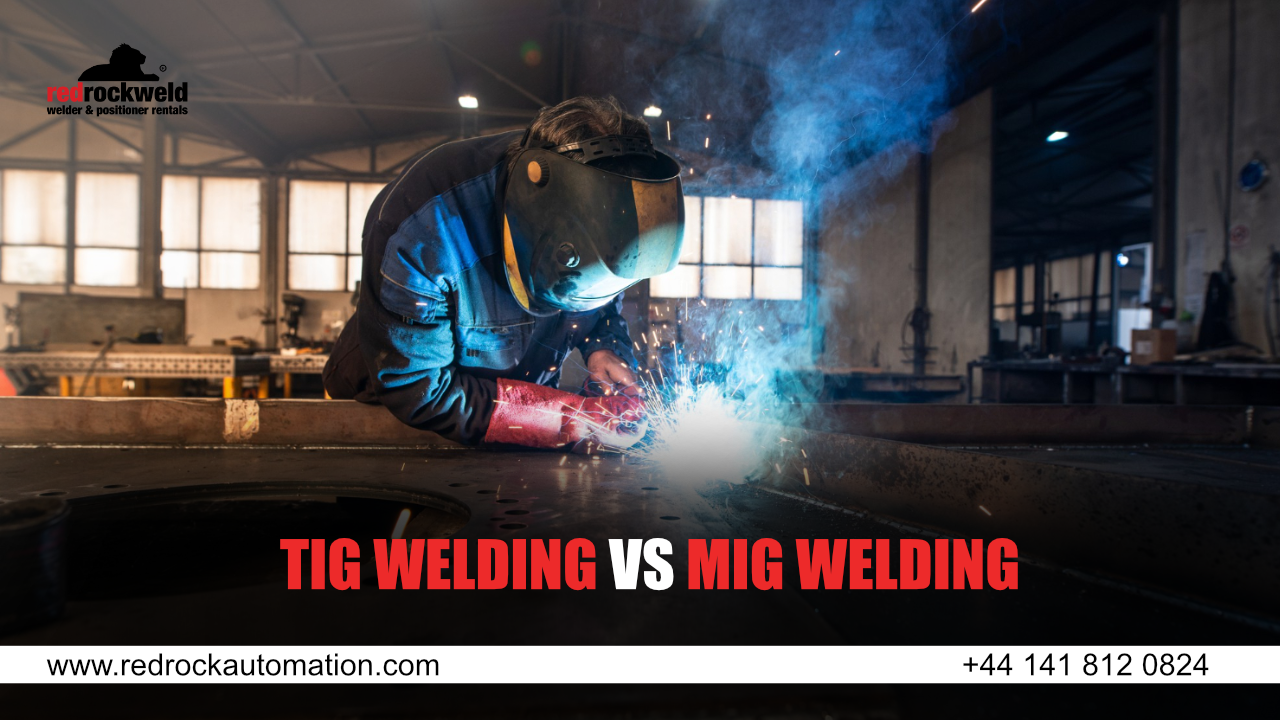
TIG Welding vs MIG Welding
Key Takeaways
- What is MIG Welding?
- TIG Welding
- TIG vs MIG: Major Differences
- Applications of MIG and TIG Welding
- Conclusion
Welding is an indispensable process in the fabrication and manufacturing sector. A strong weld out performs bolts, screws and glues in many instances, rendering permanent and sturdy joints. There are different types of welding process and amongst them TIG and MIG welding are the most widely used methods because of the control, efficiency and quality they deliver.
Confused about using either of the two for your project? This blog will detail the differences between TIG and MIG welding and help you take an informed decision.
What is MIG Welding?
Metal Inert Gas welding also known as Gas Metal Arc Welding is a semi-automatic or automatic welding process. A consumable wire electrode is continuously fed through the welding gun.
The gun also supplies shielding gas to protect the weld pool from oxidation. Inert gases such as argon are used as shielding gas. In MIG welding the shielding gas consists of 75% argon and 25% carbon dioxide.
The consumable wire acts as both the electrode and filler material. During the arc, the wire melts and fills the gap between the metal workpieces, forming a strong joint.
TIG Welding
Tungsten inert gas welding also known as Gas Tungsten Arc Welding is generally a manual process where the welder controls the torch and feeds a separate filler rod. A non-consumable tungsten electrode produces the welding arc and in that process the filler rod melts to fill the gap between the workpieces, forming strong welds. Shielding gas,usually pure argon, is used to protect the weld from oxidation.
TIG vs MIG: Major Differences
| Key Features | MIG Welding | TIG Welding |
|---|---|---|
| Arc Characteristics | Wider and less concentrated arc | Narrow and more concentrated arc |
| Electrode | Consumable wire electrode | Non-consumable tungsten electrode |
| Filler Material | Wire is fed automatically | Filler wire is added manually |
| Welding speed | Faster and more efficient welding speed | It is slower compared to MIG and hence is suited for detailed projects |
| Weld appearance | Weld appears moderately roughed or very rough at times | The welds are mostly very clean and neat |
| Metal thickness | This method is best to weld medium to thick metals | This method is well suited for thin metals that require precision |
| Compatible Metals | Aluminum, stainless steel and steel | Can weld a versatile range of metals |
| Ease of use | It is comparatively easier to operate | It takes more practice to master |
| Cleaning | More cleaning is required post-welding as it produces spatter during the process | Only minimal cleaning is required as it doesn’t produce slag or spatter |
| Productivity | Highly productive as it is 2 to 6 times faster and efficient, suitable for high volume production | It is comparatively low in terms of the productivity scale, but excels at tasks that require precision |
| Heat Control | Heat control is less as it is fixed by the wire speed and voltage | Here there is precise heat control as the welder can adjust current in real time using foot pedal |
Applications of MIG and TIG Welding
Both MIG and TIG welding methods are used across diverse industries such as
- Construction
- Automotive
- Aerospace
- Medical and food equipment
While MIG welding is used for structural components, TIG excels at fabricating fuel tanks and exhaust systems.
Conclusion
Now, which method is the best, TIG or MIG? Well, it largely depends on the project. If the project demands speed, high volume production and fabrication of thick metals, then MIG welding is the right choice. If the task deals with thin metals and requires precise, clean and quality welds, then TIG is the ideal choice.
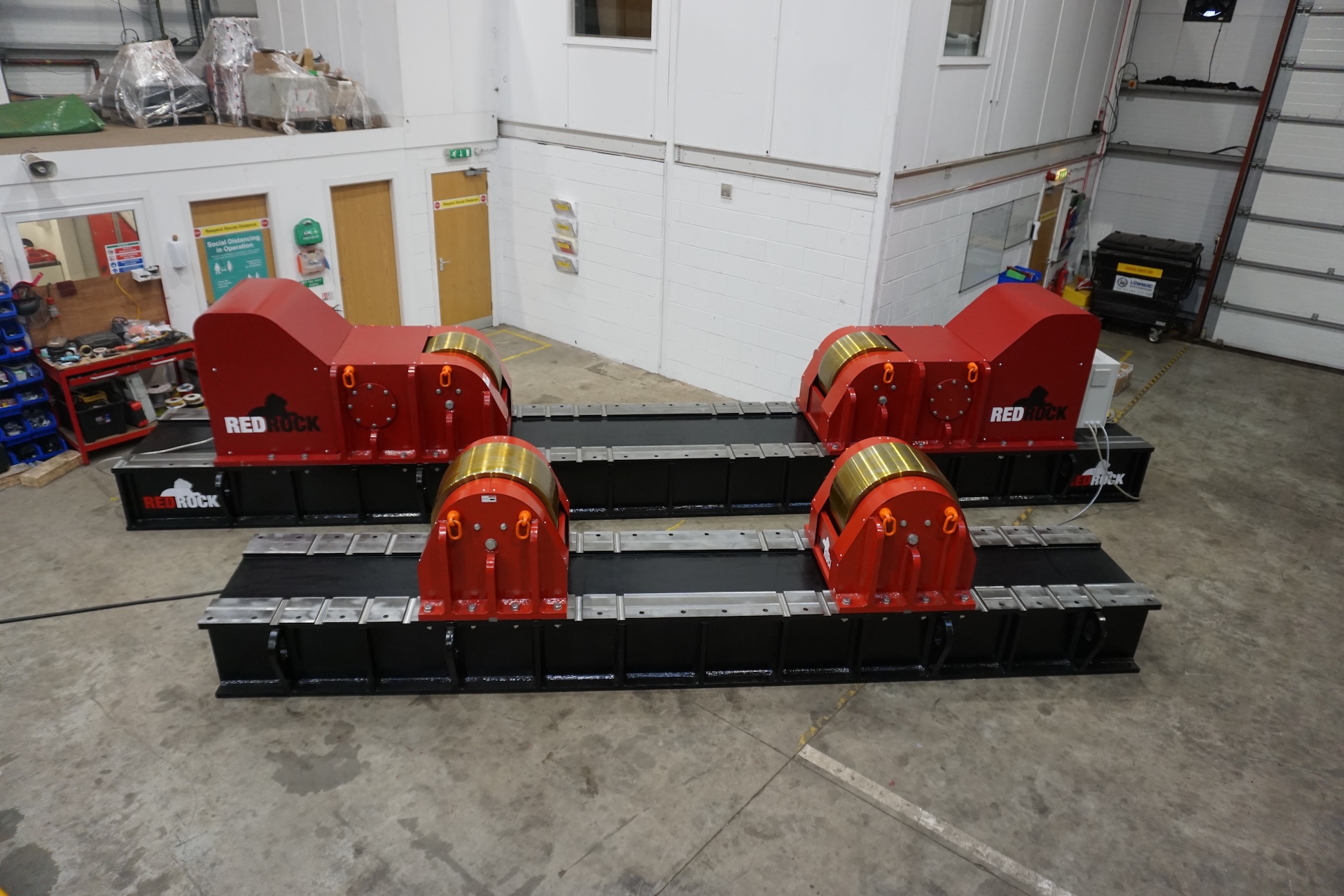
As the trusted weld and positioner rental suppliers of the UK, RedRock Automation offers high quality TIG and MIG welders designed to to meet the fabrication needs of a variety of industries, ensuring precise, reliable and consistent weld quality.